
Do You Need a Special License to Drive a Motorhome? A Guide
If you are planning a UK holiday or thinking of buying a motorhome, one of the first questions that probably comes to mind is, “Do you need a special license to drive a motorhome?” The answer depends on several factors, including the weight of your vehicle, the type of license you already hold, and how experienced you are behind the wheel.
This guide will break down UK driving license categories, explain when special permissions are needed, and provide practical tips to help you stay legal and safe on the road.
UK Driving License Categories Explained
In the UK, not all driving licenses are the same. Your entitlement to drive different vehicles depends on the category printed on your license. Most everyday drivers hold a Category B license, which allows them to drive cars and small vans.
Motorhomes often fall into a grey area for many drivers. Generally, a standard Category B license allows you to drive vehicles up to 3,500kg (3.5 tonnes) Maximum Authorised Mass (MAM). If your motorhome exceeds this weight, you may need a C1 or D1 license.
Understanding these categories before you take to the road is essential. Driving a motorhome without the correct license could result in fines, penalty points, or invalid insurance.
Weight Limits and Motorhome Classes
One of the most important factors in determining whether you need a special license is your motorhome’s weight. UK law divides motorhomes into classes based on their Maximum Authorised Mass (MAM):
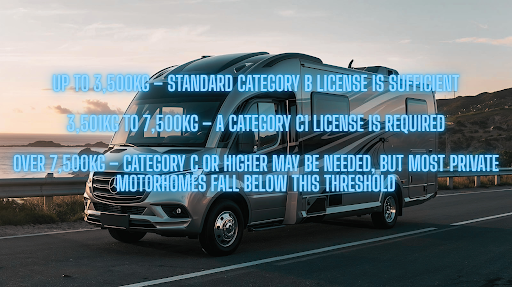
- Up to 3,500kg – Standard Category B license is sufficient.
- 3,501kg to 7,500kg – A Category C1 license is required.
- Over 7,500kg – Category C or higher may be needed, but most private motorhomes fall below this threshold.
It is important to check the vehicle registration documents or the manufacturer’s specifications to determine the exact weight. Remember that carrying extra equipment, awnings, or water tanks can add to the overall weight.
Expert Tip: Always weigh your motorhome fully loaded to ensure you stay within the legal limits for your license category.
When a Special License is Needed
Let’s get into the nitty gritty! As mentioned above, under UK law, it depends mainly on the maximum authorised mass (MAM) of the vehicle and when you passed your driving test, as to whether you need a special license or not. Below, is a more detailed explanation of the rules and regulations, so you know where you stand.
When You Do Not Need a Special Licence
If the motorhome has a MAM of 3,500kg or less, you can drive it on a standard Category B car licence. This applies to most campervans and many modern motorhomes designed to stay within this weight limit.
When a Special Licence Is Required
- If the motorhome weighs over 3,500kg, additional entitlement may be needed.
- Passed your test before 1 January 1997? You will usually have Category C1 automatically, allowing you to drive motorhomes up to 7,500kg (subject to age-related medical renewals).
- Passed your test on or after 1 January 1997 You will need to take a C1 test to legally drive a motorhome over 3,500kg.
- Very Large Motorhomes Motorhomes over 7,500kg require a Category C (HGV) licence, though these are uncommon in the UK.
Key Takeaway Up to 3,500kg: No special licence required 3,500kg–7,500kg: C1 required for most post-1997 drivers Over 7,500kg: Category C required So, if you are wondering “do you need a special licence to drive a motorhome?”, the answer is no for most standard models, but always check the vehicle’s MAM and your licence entitlements before driving.
Tips for New Motorhome Drivers
If you are new to motorhoming, understanding licence rules is only the first step. These tips will help you stay legal, confident, and safe on the road.
- Check the Motorhome’s MAM Before You Drive – Always confirm the maximum authorised mass (MAM) of the motorhome, not just its empty weight. Exceeding your licence entitlement, even unintentionally, can invalidate insurance and result in penalties.
- Know What Your Licence Actually Covers – Do not assume entitlement based on experience alone. Check the categories on your photocard licence, especially if you passed your test after 1997, as heavier motorhomes may require C1 entitlement.
- Be Mindful of Payload – Passengers, water tanks, bikes, and camping gear all count towards the vehicle’s weight. New drivers are often caught out by how quickly payload adds up.
- Consider a 3,500kg Model If You Are Unsure – If you want to avoid licence complications altogether, choosing a motorhome under 3,500kg keeps things simple and allows anyone with a standard car licence to drive.
- Take a Familiarisation or C1 Course – Even if you are legally entitled, a short training course can improve confidence when handling a larger, heavier vehicle, particularly on narrow roads, steep gradients, and motorways.
- Remember Age-Related Rules – Drivers over 70 must renew C1 entitlement and meet medical requirements. If this applies to you, ensure everything is up to date before travelling.
Common Myths About Motorhome Licenses
Motorhome licensing is an area that often causes unnecessary confusion, particularly for first-time buyers or those transitioning from caravans or campervans. Much of this uncertainty comes from outdated advice, assumptions based on vehicle size, or confusion with commercial driving rules. Understanding what is myth and what is fact under UK law can help you make confident, informed decisions, and avoid ruling out a motorhome that may be perfectly legal for you to drive.
Myth: All Motorhomes Need an HGV Licence – This is one of the most widespread misconceptions. In reality, most motorhomes can be driven on a standard car licence. As long as the motorhome has a maximum authorised mass (MAM) of 3,500kg or less, no HGV or special licence is required.
Myth: Size Determines the Licence, Not Weight – Many people assume that a large-looking motorhome automatically needs a special licence. What matters legally is the MAM, not the vehicle’s physical size. Some surprisingly large motorhomes are engineered to stay within the 3,500kg limit.
Myth: Older Drivers Can Drive Any Motorhome – Drivers who passed their test before 1997 often have C1 entitlement, but this is not unlimited. C1 only covers vehicles up to 7,500kg and must be renewed after age 70, including meeting medical requirements.
Myth: You Can Drive a Heavier Motorhome “Just Once” – Even a short journey in a motorhome that exceeds your licence entitlement is illegal and can invalidate your insurance. There are no exceptions for test drives, holidays, or emergencies.
Myth: Upgrading Your Licence Is Automatic – If you passed your test after 1997, C1 entitlement is not granted automatically. You must complete the appropriate training and pass a test to legally drive a motorhome over 3,500kg.
Understanding these misconceptions helps avoid unnecessary worry, and ensures you choose a motorhome that fits both your lifestyle and your licence. Peace of mind is priceless!
Final Thoughts
Driving a motorhome in the UK is far more straightforward than many people expect, but getting the licence side right is essential. As this guide has shown, most motorhomes can be driven on a standard Category B licence, provided they do not exceed 3,500kg MAM. Heavier models may require C1 entitlement, particularly for drivers who passed their test after 1997, while true HGV licences are only needed in rare cases.
The key themes to remember are simple: weight matters more than size, licence entitlements are not the same for every driver, and assumptions, especially around HGV rules, often lead to unnecessary confusion. Staying within your licence limits protects you from fines, invalid insurance, and avoidable stress while travelling.
Before setting off, take a few minutes to check your driving licence categories, confirm the motorhome’s maximum authorised mass, and factor in the weight of passengers and equipment. If you are unsure, it is always wise to consult the DVLA or a reputable motorhome dealer for clarification.
With the right knowledge and preparation, you can focus on what really matters: enjoying the freedom of the open road and making the most of your motorhome adventure. Safe travels!